イン・ザ・メガチャーチ and Israel

「イン・ザ・メガチャーチ」“In the Mega Church” (In the Mega-church) is the latest novel by Ryo Asai, which recently won the 2026 Japan Booksellers’ Award. Rather than a full review, I want to address three specific mentions of Israel within the book.

I was quite surprised by the first mention, where a character notes that her university friends, Jessica and Nana, are boycotting certain companies to prevent money from going to Israel. There is no explanation, no background, and no further detail provided.

There are two other similar mentions in the book. It feels like a clear depiction of peer pressure; the character doesn’t seem to think deeply about the cause itself, but rather acts out of a desire to avoid criticism from her friends.

After reflecting on this, I realized how it connects to the book’s central theme: the culture of “Fandom” in Japan. This culture of “Oshikatsu”—dedicating immense time, money, and effort to an idol—can often mirror a religion or a “mega-church.” This is the bridge. It is a new, religion-like behavior where people follow a set of rules without requiring a deep explanation. The same logic applies to the mentions of Israel: many people follow TikTok trends or social cues blindly, without questioning the “why” behind their actions.

In Asai’s world, it seems activism has become just another form of fandom—a way to belong to the ‘church’ of the moment. It makes me wonder: are we supporting causes because we believe in them, or because we are afraid of being the only ones left outside the cathedral?

The Cure’s song “Jumping someone else’s train” keeps playing in my head when thinking about this. Released in 1979, it captures similar idea of following fads and trying to conform:

It’s the latest wave that you’ve been craving for

The old ideal was getting such a bore

Now you’re back in line

Going not quite as far but in half the time

Everyone’s happy, they’re finally all the same

‘Cause everyone’s jumping everybody else’s train
GDP Per Capita

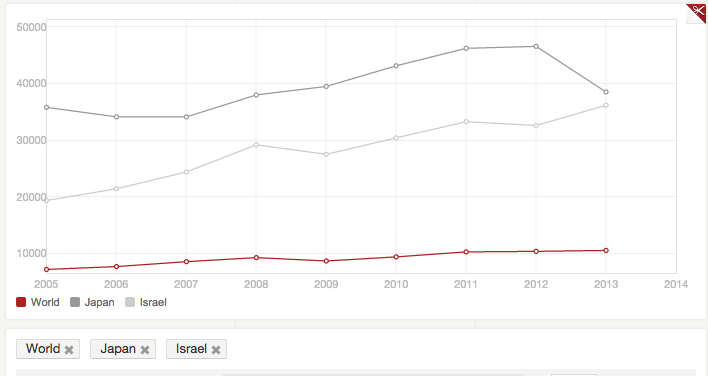
Was interesting for me to compare the GDP per capita between Israel and Japan.

Search on Google provides the following information:

GDP Per Capita Japan (2013): 38,492

GDP Per Capita Israel : 36,151

But!

While Israel is growing, Japan is shrinking.

(Source: Worldbank.org)

Gdp Per Capita comparing Japan Israel


Big Bad Wolves


“Big Bad Wolves” , in Japanese “オオカミは嘘をつく” is playing in selected theaters in Japan.

Interesting enough, the Japanese title is slightly different from the English title which is also different from the Hebrew one. In Hebrew, the literal translation is “Who is afraid of the big bad wolf” . In Japanese, “Wolves lie” .

It is very rare for an Israeli film to play in Japanese theaters.So, it is either a good one, or a very political one.

In this case, a good one. A film which received good reviews in several film festival including a quote form Quentin Tarantino calling it “the best film of 2013”.

A bit on the horror side, a bit on the funny side (which does not translate well to Japanese), highly recommended thriller.


Signs

One can find signs everywhere if he wants to.

Today was “Israeli”, with Israel and Hebrew surrounding me… Or not.

1. Morning show (FujiTV) had an おもてなし (hospitality) lesson to foreigners featuring two Intelligent and fun Israeli girls
2. Had dinner with a Jewish friend and chatted about Jewish holidays
3. On the train back home bumped into a Japanese acquaintance who speaks Hebrew
4. A bit later a girl standing in front of me was carrying a bag with “Tel Aviv” written on it (together with other city names)

So, do I choose to find it symbolic or mark it is an interesting coincidence?

Damage Control 101 – Blow out of proportions

I may be speculating here, but the Iran Virus story and media coverage made me think.

Facts:

  1. Siemens SCADA systems around the world were hit by Stuxnet virus.
  2. Some of the systems are in Iran
  3. From BBC report: “Stuxnet was first detected in June by a security firm based in Belarus, but may have been circulating since 2009.”
  4. “Siemens was neither involved in the reconstruction of Bushehr or any nuclear plant construction in Iran, nor delivered any software or control system,” he said. “Siemens left the country nearly 30 years ago.”
  5. “Siemens said that it was only aware of 15 infections that had made their way on to control systems in factories, mostly in Germany.”

Yet the Media speculates:

  • “The sophisticated super virus Stuxnet” – Deutche Welle
  • “One of the most sophisticated pieces of malware ever detected was probably targeting “high value” infrastructure in Iran, experts have told the BBC.”
  • “Stuxnet’s complexity suggests it could only have been written by a “nation state”, some researchers have claimed”
  • “The fact that we see so many more infections in Iran than anywhere else in the world makes us think this threat was targeted at Iran and that there was something in Iran that was of very, very high value to whomever wrote it,” Liam O’Murchu of security firm Symantec, who has tracked the worm since it was first detected, told BBC News.

Facts seem to contradict the speculation, but the story becomes more interesting, doesn’t it?

However, Mr O’Murchu and others, such as security expert Bruce Schneier, have said that there was currently not enough evidence to draw conclusions about what its intended target was or who had written it.

And now my speculation:

As Siemens are obviously do not actively involve themselves in the PR and reports of  “some researchers have claimed”, it looks like Symantec are doing all they can do to blow this story out of proportions. This is not a story of “Symantec software failed to identify and stop a malware”, but “Symantec cannot possibly identify and stop such a sophisticated Super Virus written by a Nation State”.

There Goes Advanced PHS (XGP)

As previously reported, Israeli Startup Altair Semiconductors was supposed to Supply chips to Willcom’s XGP network .

XGP was never a world-wide standard, but Willcom’s attempt to keep PHS alive. It now looks like XGP (or Advanced PHS) will not be deployed.

Willcom announced today their plan to file for bankruptcy  (See Japan Times and NYT for more details) after a steady decline of their customer base.

I don’t know what kind of commitments Altair Semi received from Willcom, but I certainly hope their WiMAX and LTE business will be more successful.

Indian Visa Anomaly

As I am planned to visit India next month for business and my previous Visa expired, I visited the Indian Visa Application Center website to understand what I need to arrange beforehand.

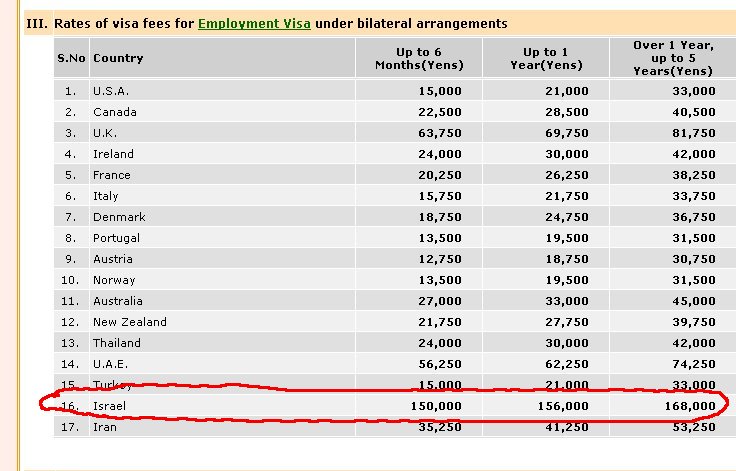
As I was browsing, I found a strange anomaly in the Employment visa section:
Visa for Israeli citizens cost 10 (6 months period) to 5 (1-5 years) times than a Visa for US citizens.

I wonder why? Is it because Israeli are richer than US citizens? Do Israeli application requires a different and more expensive process?

See below (and on the website):

India Visa

Israeli Siano powers Softbank Mobile's iPhone OneSEG

softbank-logo2

Published in Israeli The Marker [HE]: Israeli Start-Up Siano ‘s chip SMS1130 is powering  Softabank Mobile’s 1seg (Japanese: ワンセグ) iPhone adapter.

This  iPhone adapter is both a 1seg (ISDB-T) TV Tuner and a battery pack,  on sale for 9,840 ¥.

Apple iPhone’s lacked this important feature, which is now a standard in most Japanese cellular phones. About 100$ is a bit expensive in my opinion, but I am not watching TV anyway.

Miya Water

Not related to Japan or Wireless Technology, but a very interesting company.

Miya Water, an Arison group company, specializes in leaks, not Software memory leaks, but Water leaks. It is reported that Arison group invested $100 Millions into this company, and they aim to lead the world in preventing water from leaking out of the Urban water system.

I like it!I like relatively simple idea (Though I am sure the technology is not simple).

Miya Water, and Better place, two new Israeli cleantech companies that will change the world.

(Oh, and someone should tell Miya’s web designer to test the website with Firefox before releasing it to the Public).

Runcom Technologies to invest in IXI Mobile

Here is a PR I could have never anticipate:

Runcom Technologies to invest in IXI Mobile.

Runcom Technologies is a Israeli Startup developing WiMAX chipsets and devices, while IXI Mobile develop the OGO Device, a Messaging device working in Cellular Networks.

The PR is very clear, while I don’t really understand the “why”.

The parties believe that this partnership creates a synergy that is intended to enable them to combine IXI’s leading technology with Runcom’s WiMAX (4G) capabilities for mobile and fixed rich media solutions. The parties intend to develop new services, devices and software clients in addition to large data convergence projects. Furthermore, the parties believe that this transaction will enable them to leverage each others’ existing customer base, while expanding based on new offerings

For which market do Runcom intend this device?

Disclaimer: I believe I still own IXI Mobile stock from the short period I used to work there, but I am sure they amount to nothing.