Posted by Avi Telyas on Jul 13, 2009 in
LTE,
WiMAX
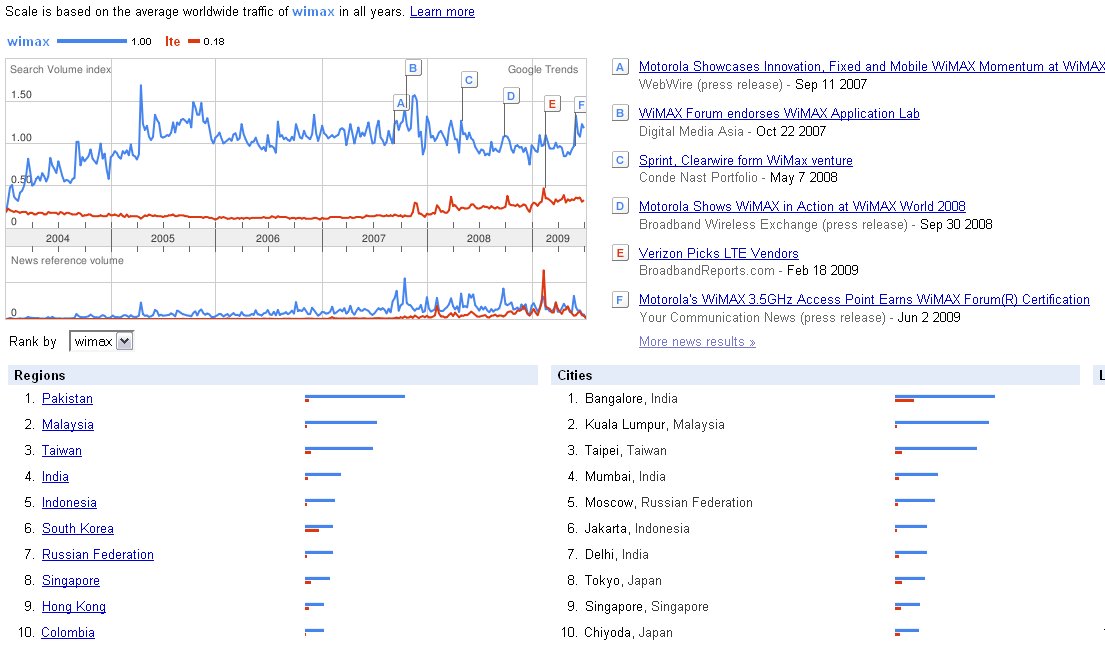
Following the recent LTE press releases, I decided to revisit Google Trends and see how WiMAX is doing.
WiMAX search term is still leading over LTE. I don’t find it surprising that Pakistan and Malaysia are the leading regions for WiMAX searches as there are real deployments there, while in South Korea LTE is gaining some ground (but still only about half of “WiMAX”).

Tags: Trends
Posted by Avi Telyas on Jun 23, 2009 in
LTE

Israeli Startup Altair Semiconductors announced today the availability of their LTE baseband processor. Named FourGee-3100, this is the first in a series of LTE portfolio.
This is Altair’s 3rd chip following the FourGee-2150 for Mobile wiMAX and FourGee-4150 for XGP. I don’t believe the FourGee-2150 is widely deployed nor gained siginificant design wins, but as reported earlier, the FourGee-4150 XGP powers Japanese Willcom new XGP network .
Altair announced their plans for:
- FourGee(TM)-6150 – a MIMO RF transceiver that supports LTE-TDD. This product will be available in August 2009
- FourGee(TM)-6200 – a multi-band LTE-FDD MIMO transceiver that supports the most popular LTE bands in North America, Japan and Europe. The chip will be available in Q210
LTE-FDD will arrive in Q2, 2010, long after trials are expected to start in Japan. Will Altair gain enough market share with the LTE-TDD? We shall soon find out.
Tags: Altair Semi, Willcom
Posted by Avi Telyas on Feb 17, 2009 in
Japan,
LTE

Softbank Mobile will start LTE trial in Mito City (Ibaraki Perfecture). Trial license is from Feb. 17 to Dec. 31 2009.
This is the first LTE field trial in Japan, and an important step for LTE internationally. It is not reported which vendors participate in the trial.
Tags: LTE, Softbank Mobile
Posted by Avi Telyas on Feb 14, 2009 in
LTE

Although already demonstrated at several conferences, a new PR from Fujitsu to attract more attention to their LTE solutions.
The BroadOne eNodeB is based on a “new” architectural concep, consisting of a Remote Radio Head (RRH) and Base Band Unit (BBU).
Fujitsu has developed a 3GPP-compliant LTE system for the global market. In fact, Fujitsu was chosen by NTT DOCOMO to be a supplier for its LTE eNodeB in 2006 as well as its LTE core network system in 2008, and is now taking this technology leadership to the rest of the world. In a joint demonstration with NTT DOCOMO, more than 250 Mbps performance was exhibited in an outdoor environment over the Fujitsu LTE eNodeB; also demonstrated at both CEATEC Japan 2008 and CTIA Wireless 2008 in Las Vegas.
Fujitsu LTE Solution Page has some more information, but I am missing Datasheets, Use Cases, and Marketing collaterals.
Fujitsu, please improve your website. Take example from Motorola LTE.
Tags: Announcement, Fujitsu, LTE
Posted by Avi Telyas on Dec 24, 2008 in
Business,
Japan,
LTE,
Mobile
Some more information from the Japenese MIC (Internal affairs and Communications).
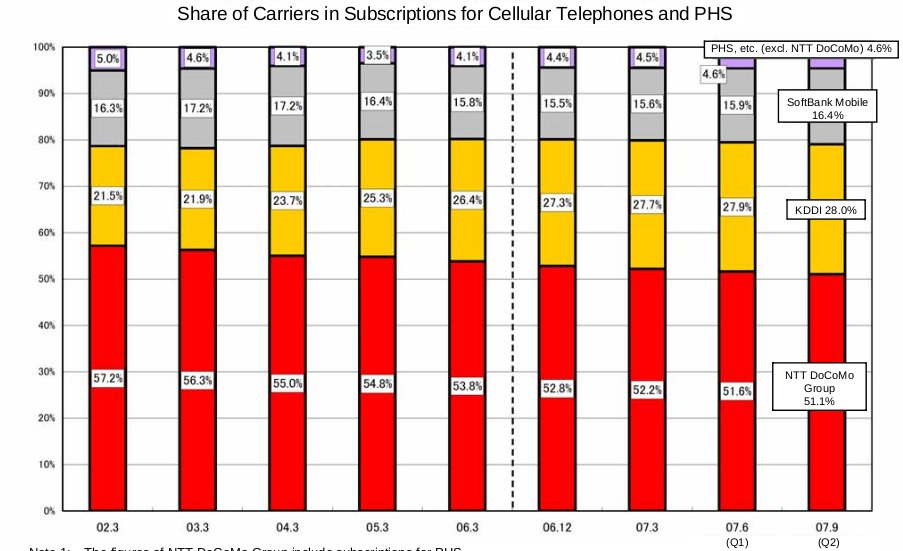
Share of Carriers in subscription for Cellular Phones and PHS:

Docomo still lead, while KDDI increase their market share.
As for LTE: KDDI, Docomo and Softbank already have LTE plans, so it seems the future competition in Japan will not be about Cellular Technology and Coverage, but for additional services (and marketing).
Softbank, while pursuing LTE technology and supposedly selected Huawei for trial, also prefers to deploy HSPA+ while waiting for the LTE market to mature and cost to be driven down.
Posted by Avi Telyas on Dec 22, 2008 in
Japan,
LTE,
WiMAX
WiMAX Forum PR
Mobile WiMAX is currently available only for TDD, while Release 1.5 will introduce FDD. Most cellular technologies today are FDD based, while LTE is defined for both. (Did I mention LTE and Mobile WiMAX are not that different?)
Rule Number One of Wireless Communications: No Spectrum -> No Business
(Well, except non-licensed band, but let’s keep it for another Post).
This is an important step taken by the Japanese regulator to push IMT-2000 and Advanced forward, and allowing Japanese Mobile operators the room to grow!
Posted by Avi Telyas on Dec 18, 2008 in
Business,
Japan,
LTE
This Press Release really is really confusing.
Docomo, as in “Japan Mobile Operator DoCoMo” has developed a MIMO LTE chip. I can understand why LG is doing so, but Docomo?
Do they really plan to sell the chips to Mobile phone manufactures?
I can only think of one reason, which is that Docomo wanted to push the LTE market. Developing a chipset was probably the best solution.
This excerpt is the perfect example of “Too much information”:
In the new chip, which is made with 65-nanometer processing, the circuits have been further optimized, particularly by eliminating redundant circuits for computationally complex processes such as MIMO-signal detection and error-correction decoding
Do I really care about the complexity of the process?
Posted by Avi Telyas on Dec 18, 2008 in
Business,
LTE
From Hold to Sell.
I don’t really disagree with the analysis, just found one sentence a bit amusing:
However, the company has not reacted to this and is still planning for a flattish 2009 infrastructure market
So, if Ericsson laid-off 10% of their staff their stock wouldn’t have been downgraded?
Posted by Avi Telyas on Dec 17, 2008 in
LTE
Visited 3GPP webpage today and was surprised to see different design.
Don’t know exactly when it happend (I am sure in the last two months), but this new design is a big improvement from the old design. New colors (Green), informative and clear. I guess someone in the 3GPP understood LTE-WiMAX battle is not only about Technology, but also (or maybe mostly) Marketing.
![LTE Logo]()
Posted by Avi Telyas on Dec 17, 2008 in
LTE
3GPP has approved the functional freeze of LTE as part of Release 8.
It is an essential step for formal ratification and actual deployment.
LTE is aimed at providing the true global mobile broadband experience for users but also places high priority on improving spectral efficiency and reducing cos